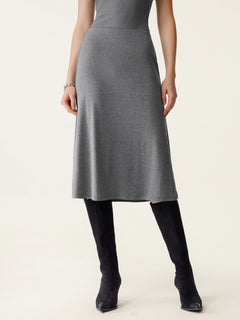
Quick Answer: There is no single skirt length that looks best on everyone. A reliable choice is a hemline that does not stop at the widest part of your leg. For many women, this means just above the knee, just below the knee, or near the narrowest part of the ankle. The right option also depends on the movement, coverage, and formality the occasion requires.
Key Takeaways:
-
Judge where the hem falls on your leg, rather than relying only on mini, midi, or maxi labels.
-
Compare hemlines slightly above and below the widest part of your calf.
-
Test every skirt while standing, sitting, walking, and using stairs.
-
Consider your height and proportions without treating body-shape advice as a fixed rule.
-
Fabric structure, lining, stretch, footwear, and dress code can change how a skirt length works.
How to Choose the Hemline?
Terms such as mini, midi, and maxi describe broad length categories, but they do not reveal exactly where a skirt will finish on your body. Height, leg length, rise, and the position of the waistband can all change the final hem placement.
| Hem position | Best for | Consider before choosing |
|---|---|---|
| Mid-thigh | Casual outfits and showing more leg | Check coverage when sitting or bending |
| Just above the knee | Versatile everyday and workwear styling | The exact dress code still matters |
| Just below the knee | Polished outfits with more coverage | It may shorten the visible leg line if it ends at the widest part of the calf |
| Mid-calf | Elegant midi looks | The proportions may feel clearer when the waist is visible or defined |
| Ankle length | Coverage, travel, and relaxed formal looks | Check whether the hem interferes with walking or stairs |
| Floor length | Formal occasions | Confirm that the hem clears the floor with the intended shoes |
Use this table as a starting point rather than a universal formula. Two skirts described as midi length may fall several inches apart on the same person, so the actual hem position is more informative than the product label.
Body Type and Proportion Considerations
Body-shape guidance can help narrow the options, but it should describe possibilities rather than impose rules. The waistband position, skirt construction, and relationship between torso and leg length often matter as much as the named body type.
Petite Figures
Petite refers to shorter vertical proportions, not one particular body shape. Just-above-the-knee skirts can preserve more visible leg, while midi and maxi skirts can also work when their lengths are scaled appropriately.
For a midi skirt, compare a hem that finishes below the knee with one that ends after the widest part of the calf. An ankle-length skirt should expose enough of the foot to allow easy walking and prevent the outfit from appearing unintentionally floor-length.
A visible waistline, limited bulk, and a clear shoe shape can help maintain proportion, but petite women do not need to avoid longer skirts automatically.
Tall Figures
Tall women generally have more room to work with longer midi, ankle, and floor-length skirts. However, standard skirts may sit higher than intended, turning an expected midi into a knee-length style.
Pencil skirts do not require heels to maintain proportion. Flats, loafers, boots, and heels can all work when the skirt allows a comfortable stride and the shoe relates clearly to the hem.
Tiered panels, contrasting textures, or a visible waistband can break up a long vertical line when that is the desired effect.
Pear-Shaped Figures
For proportions with fuller hips relative to the upper body, an A-line or gently flared skirt can provide room through the hips without depending on stretch.
Knee and midi lengths are both practical options. Pay particular attention to whether the skirt pulls across the hips and whether the hem ends at the fullest part of the calf. A skirt that fits the hips properly will usually create a cleaner line than sizing down for a narrower silhouette.
Hourglass Figures
Pencil, bias-cut, wrap, and softly flared skirts can all work with balanced shoulders and hips and a defined waist. The deciding factor is whether the waistband stays in place without creating tension through the seat.
Lengths near the knee can create a concise silhouette, while longer midis provide more coverage and movement. Stretch should support comfort without causing the skirt to ride upward as you walk.
Rectangle or Straight Figures
Pleats, panels, wrap details, and fuller A-line shapes can introduce dimension, while straight column skirts can maintain a clean, minimal line.
A high or clearly defined waist may alter the apparent balance between the torso and legs. Instead of choosing length based only on body shape, decide whether you want a continuous vertical line or more separation between the upper and lower body.
Apple or Round Figures
Flat-front or gently elasticized high-waist skirts can provide support without concentrating bulk at the midsection. A-line, straight, and softly draped silhouettes are all possible when the waistband remains comfortable while sitting.
An open jacket, untucked top with a deliberate stopping point, or tonal outfit can establish vertical continuity. Avoid assuming that longer is always better; the most useful length is one that provides coverage without restricting movement or overwhelming the rest of the outfit.
Choosing Length for the Occasion
Skirt length contributes to formality, but it does not determine it alone. Fabric, construction, footwear, transparency, slit height, and the rest of the outfit must also be considered.
Emily Post (established etiquette authority) distinguishes between casual, business casual, semi-formal, and black-tie clothing, with both short and long skirts appearing in different categories. This reinforces a practical point: context and styling matter alongside hem length.
Casual Outings
Mid-thigh, knee-length, midi, and maxi skirts can all suit casual plans. Choose according to the weather and expected activity rather than trying to identify one ideal length.
For walking, sitting outdoors, or cycling, test coverage and movement beforehand. A longer skirt is not necessarily more practical if it catches underfoot or restricts the stride.
Work and Business Casual Settings
Just-above-the-knee, knee-length, and midi skirts are common starting points for professional outfits. However, office standards differ by employer, industry, role, and location.
Check the skirt while seated, especially if it has a front slit or stretch fabric. A hem that appears appropriate while standing may rise considerably at a desk or during a meeting.
Travel and Commuting
Midi and ankle-length skirts can offer coverage during long journeys, but the silhouette needs enough room for stairs, luggage, and extended sitting.
Look for a stable waistband, practical pockets, manageable volume, and fabric that recovers reasonably after sitting. Keep floor-length hems clear of escalators, station platforms, and wet pavement.
Formal Events
Midi, ankle-length, and floor-length skirts can all appear formal when made from suitable fabric and paired with a refined top or jacket. Satin, velvet, crepe, silk blends, and structured jacquard can raise the level of formality.
For floor-length styles, try the complete outfit with the intended shoes. The hem should skim above the floor rather than drag or require lifting throughout the event.
When Practical Needs Matter More Than Body Type
Body-shape guidance should not override the demands of the occasion. For commuting, travel, or events involving stairs, prioritize stride, coverage, and hem clearance. For work, check the actual dress code rather than assuming every knee-length or midi skirt is appropriate. For formal events, fabric, construction, and styling may influence formality as much as length.
Comfort is also part of appearance. A skirt that requires constant pulling, lifting, or waistband adjustment is unlikely to look composed in real use, even if its proportions seem correct in a still photograph.
How Fabric Changes the Effect of Skirt Length
Two skirts with the same measured length can look very different. A structured A-line skirt holds its shape away from the legs, while a bias-cut or lightweight skirt follows the body more closely.
Utah State University Extension (university-based clothing and textile education resource) explains that shape relates to the overall silhouette of a garment. In practice, this means hem placement should be assessed together with the skirt’s structure, volume, and surface texture.
Consider these practical differences:
-
Structured fabrics: Hold a defined silhouette and may make an A-line or pleated hem appear more prominent.
-
Fluid fabrics: Follow movement closely and may reveal the leg shape beneath the skirt.
-
Sheer fabrics: Require checking both the outer hem and lining length, particularly in daylight.
-
Stretch fabrics: May ride up after walking or sitting, making the worn length shorter than the standing length.
-
Heavy hems: Can improve vertical drape but may feel restrictive if the skirt is narrow.
-
Bias-cut fabrics: Can lengthen or shift slightly while hanging, so allow the garment to settle before judging or altering it.
A Three-Step Skirt-Length Check
-
Stand naturally: Look at the skirt from the front and side. Check whether the hem stops at a narrower or wider part of your leg.
-
Sit and walk: Confirm that the skirt provides enough coverage, permits a natural stride, and does not ride up or twist.
-
Try the intended shoes: Flats, ankle boots, tall boots, and heels change how much of the leg is visible. Judge the skirt as part of the complete outfit.
If the hem visually cuts across the widest part of the calf, compare it with a version that finishes slightly above or below that point. Even a small adjustment can produce a noticeably different proportion.
Styling the Final Length
Once the hem position feels right, use the rest of the outfit to create a deliberate proportion.
Coordinate the Waistline
A tucked or shorter top reveals more of the skirt and makes the waistband part of the silhouette. An untucked top creates a different visual stopping point, so check where both the top and skirt divide the body.
Consider the Space Around the Shoe
With midi skirts, showing part of the lower calf or ankle can create separation between the hem and shoe. Tall boots can also work, particularly when their tops sit beneath the skirt rather than creating a narrow, accidental gap.
For floor-length skirts, shoe height affects safety and hem clearance more than perceived height.
Check Slits and Asymmetrical Hems
A slit changes both coverage and mobility. Sit down and take a full stride to see how high it opens. With asymmetrical or high-low hems, assess the shortest point as well as the overall length.
Use Alterations Selectively
Shortening a simple straight or A-line skirt is often possible. Altering a pleated, tiered, bordered, or sharply flared skirt may change its proportions or remove a design detail. Check the construction before treating hemming as an easy correction.
Final Thoughts
The most attractive skirt length is the one that creates the proportion you want while remaining appropriate and manageable in real use. Begin with the actual point where the hem meets your leg, then test movement, coverage, fabric behavior, footwear, and dress code. Body-shape suggestions can guide comparison, but they should not replace what you observe when you stand, sit, and walk in the complete outfit.
FAQ
Where should a midi skirt fall?
A midi skirt may finish anywhere between below the knee and above the ankle. If it cuts across the widest part of the calf, compare a slightly shorter or longer hem.
What skirt length is appropriate for work?
Knee and midi lengths are common choices, but workplace standards vary. Check the seated length, slit height, transparency, and your employer’s actual dress code.
Can petite women wear maxi skirts?
Yes. Look for a hem that clears the floor, a correctly placed waist, and manageable volume. Petite sizing may provide better vertical proportions than simply shortening a standard skirt.
How long should a skirt be for a formal event?
Dressy midi, ankle-length, and floor-length skirts can all work. Follow the stated dress code and judge the fabric, construction, top, shoes, and accessories together.
Can a tailor change an unflattering skirt length?
Often, but the construction matters. Straight hems are generally simpler to alter than pleated, tiered, bordered, asymmetrical, or strongly flared designs.